
Mapping the Evolution of Artificial Intelligence
A data-driven exploration of epistemic diversity and future frontiers
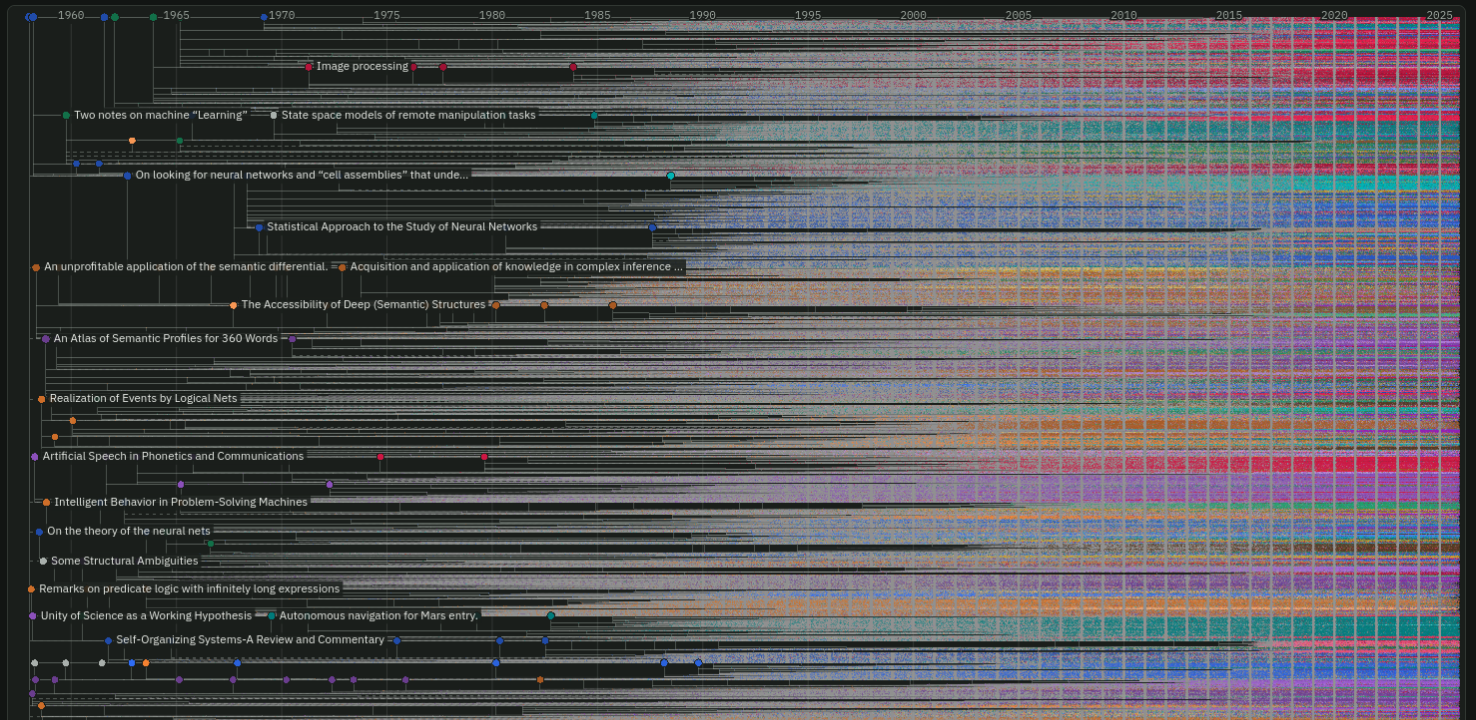
Is AI research narrowing into a scientific monoculture built on a few technologies like transformers and large language models, or does it keep a healthy diversity of ideas and methods? We are building a quantitative map of AI's 75-year history to find out.
Why
A monoculture would be risky, and nobody has measured it
AI is reshaping nearly every part of modern life, from scientific research to governance. Beneath its explosive growth, the field may be converging on a few dominant technologies and abandoning a wider range of conceptual and methodological approaches. That loss would mean less innovation, less resilience and a greater risk of technological dead ends.
Without quantitative tools that follow how AI's intellectual landscape has changed, there is no empirical evidence on whether this narrowing is real. As AI becomes embedded in society, rigorous, data-driven insight into its evolution is needed to guide future research and keep the field innovative and epistemically resilient.
Goals
01
A longitudinal dataset
Publications, conference papers, citations, patents and funding records from sources like OpenAlex and Dimensions, plus the largely informal literature of AI's beginnings.
02
Seeing the structure
Computational methods to visualise how the field's structure has changed over 75 years.
03
Emergence and convergence
Tracking how AI subfields emerge, branch and converge.
04
Measuring diversity
Quantitative metrics for epistemic diversity: the variety of research approaches within AI.
Approach
AI's history as a living epistemic ecosystem
- Language models
- Embeddings from natural language processing models capture how concepts relate across decades of research.
- Complex networks
- Network analysis maps the relations between publications, authors and institutions.
- Phylogenetic networks
- How concepts cross-pollinated between subfields: shifts in meaning, unlikely combinations and roads not taken.
Impact
Solid quantitative data on whether AI is narrowing into a monoculture or keeping its diversity, so that its history becomes a living resource rather than a closed chapter.
By revealing hidden biases in AI's trajectory and finding neglected but promising subfields, the interactive maps support strategic discussions about where to go next. They are meant for researchers, policymakers and the public, and show AI not as a story of inevitable progress but as a web of research threads embedded in a larger context.
Team
Complexity Science Hub
Sony Computer Science Laboratories Rome
Funding
Duration
1 Jan 2026 – 31 Dec 2026